The Shoah – How The Past Becomes The Present

The Shoah – How The Past Becomes The Present

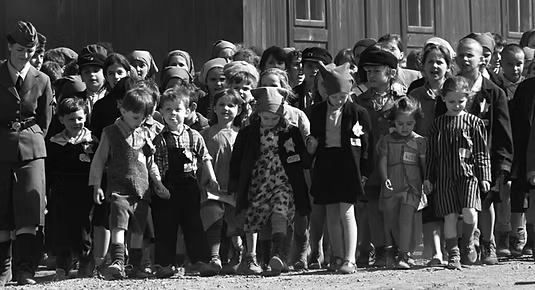
There are no words that can ever explain the scale and gravity of what happened during the Shoah. My mother lost her parents, four sisters and a brother, who were murdered in the gas chambers of the Auschwitz and Belzec death camps.  She was left alone by the time she was 16, living in the Krakow Ghetto and was deported to the Plaszow concentration camp in June 1942, before her 17th birthday.  The camp’s SS commander became Amon Goth by early 1943. He was known as the “Butcher of Plaszow.”   How could anyone even begin to really understand what she went through, not to mention the magnitude of the atrocities inflicted on so many other Jewish and non-Jewish lives that survived and didn’t in the Holocaust.

My mother had been defined by her past, and probably many of the nearly 6.5 million survivors of the Holocaust.  It’s the legacy of trauma for their memories of something that unconscionable that has never probably left their minds.  How could it?  Their past became the present.

My mother’s holocaust survivor trauma, even if some of it had been reconciled nearly 20 years after liberation had to be retriggered, probably even impacting her far more than during her past when her husband left her when she was pregnant for a German woman.  We were living in one Chicago’s largest Jewish communities in the early 1960’s, filled with Holocaust survivors.  But her underserved lifetime of hatred for my stepmother and every other German that my brother and I inherited never should have happened.  How she penetrated him with hatred, even far more than me helped lead to his nervous breakdown.  He was institutionalized before he reached 30.  His fate also nearly became mine.

I’d mentioned how my mother’s trauma manifested to remember how the Shoah happened.  The origin of the Holocaust was racist ideology – fundamental Nazi idealism.  The hatred of others that were perceived as a threat to the Aryan race, especially Jews. Its effectiveness was executed in the manipulation of people’s minds – channeled through propaganda and conspiracy.  It was seen as ethnic cleansing based upon nothing that was real.

My mother’s hatred for my German stepmother and every other German was also based only upon perceptions of who they were.  But her beliefs rested upon nothing more than her own bias. They were shaped by what she’d gone through, not something that was being done to her.  Still, how can I blame her for how she saw the world and probably many other survivors after what they’d been through in the Holocaust.  I know how often it’s probably haunted them in so many ways.  But even with every bit of compassion I’ve had for my mother and what every other survivor had gone through, the past for mother and for every survivor can’t be turned into the present.  If nothing else, the consequences for me and unconscionably for my brother can’t be measured.

I guess remembering the Holocaust and the trauma of survivors, even far more nearing Yom HaShoah that probably often uncontrollably has been passed on to their children, subsequent generations and what future generations may need to bear is the plea for the world to see how the past continues in the present.   I am not in any way implying the trauma of survivors actually could be ever be unconditionally reconciled.  But we do have to learn from what happened in the Shoah to let only the truth be the truth.  The Nazis illusion of reality being nothing more than the racist perceptions of people – namely Jews, but also the racial hatred of far too many other ethnicities and the marginalized, which penetrated throughout nearly everywhere in Germany, the rest of Europe, and within far too many others in every other part of the world.

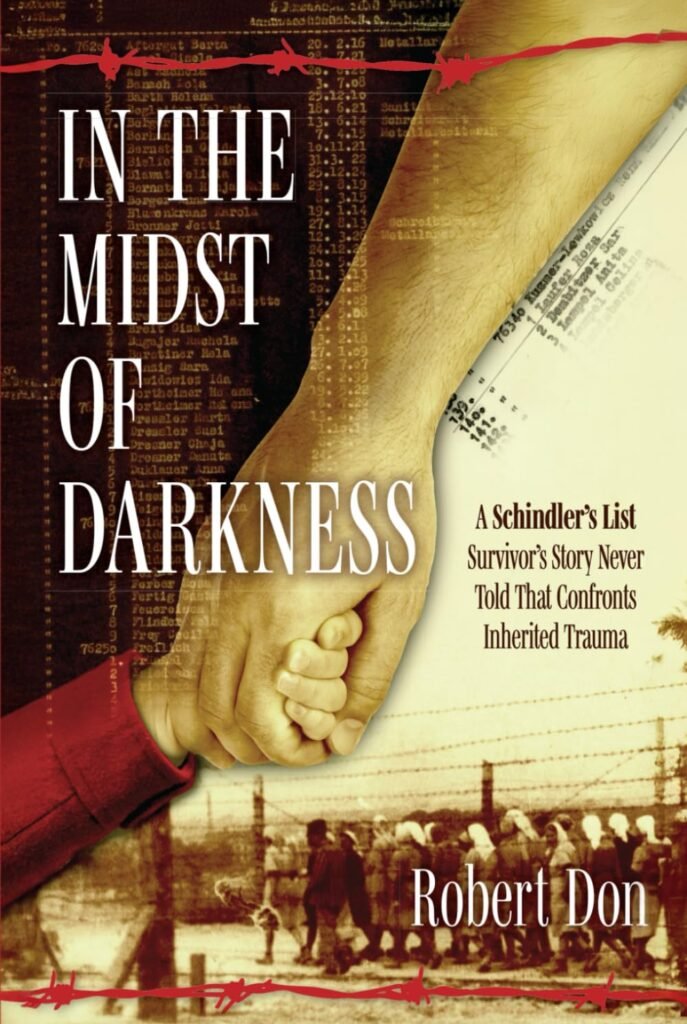
But the unrelenting irony of my mother’s hatred for Germans and how my brother and I grew up, as told in my memoir, “In The Midst of Darkness” – her life and over 1200 other Jewish lives in during the Holocaust were saved by a Nazi German – Oskar Schindler.  She never told me that she was a “Schindler’s List” survivor.  On Yom Kippur day, October 1993, my rabbi’s sermon in synagogue was the story of “Schindler’s List.”  The film would debut in the next six weeks.   It had been five years after my mother passed away.  At the end of the Rabbi’s speech, my father who was sitting next to me in synagogue leaned over and told me something that she never did.  It was six words that I would never forget – “Your mother was on that list.”

In synagogue that day, 40% of the congregation were Holocaust survivors. Some I knew personally having lived in the neighborhood where the synagogue was located growing up.   I can’t even imagine what they might have been feeling, hearing in their schul the first major story of the Holocaust that Steven Spielberg turned into a movie. Most importantly, it was a story of a Nazi German saving Jewish lives. A person who turned righteous when so few did, in history’s darkest era the world has ever known.  Some of the survivors in synagogue that day might have been like my mother, who were traumatized and hated all Germans.  But could hearing this story have changed anything for them? I have to believe it might have reconciled at least some of what they felt. How could it not?

The trauma of survivors does feel real and needs every bit of reach we have given them to share their stories, more often probably being part of the healing process.  But as I’ve told, it doesn’t only impact them.  Too often, it also shapes their descendants.   The numbers are staggering: 10 to 15 million people, if not more may be living with the legacy of this trauma, yet it’s often unspoken.  Of which, 7-8 million direct descendants of survivors are Jewish and may be impacted by generational trauma.  That is approximately 50% of the world’s Jewish population.  Their stories also need to be heard to the same reach I feel that we’ve given survivors.  If they’re not, how can they change the behavior they need to confront.  The silence may continue to leave them without enough awareness needed to really let them reconcile their trauma.

As the survivor population has abated over the past 25 years, the stories of descendants of survivors become even more desperately needed to be told. The Shoah Foundation that Steven Spielberg founded in 1994, being his vision for “Schindler’s List” and its right of passage for survivors to tell what happened to them in the Holocaust would have meant everything to my mother.  If she would have been able to share what she endured and lost, it may have helped prevent some of her trauma that my brother and I inherited.  That type of voice is also needed for the descendants of survivors, especially understanding the scale of how many are potentially being impacted by generational trauma due to the Holocaust.

Intergenerational Trauma – The Hidden Voices After The Holocaust

Intergenerational Trauma – The Hidden Voices After The Holocaust

While much has been told about the atrocities of the Holocaust survivors, their descendants have trauma too.
There has been so much shared of survivors’ accounts of the atrocities they lived through in the Holocaust, but not nearly enough of the trauma they’ve passed onto their children, their children’s children, and what future generations may have to bear. If we only consider the approximately 11 million victims who were murdered in the Holocaust, there must be at least that many survivors of family members/relatives, who probably have been inflicted with survivor trauma. That also doesn’t consider that many descendants of survivors may live with generational trauma.

There has been so much shared of survivors’ accounts of the atrocities they lived through in the Holocaust, but not nearly enough of the trauma they’ve passed onto their children, their children’s children, and what future generations may have to bear. If we only consider the approximately 11 million victims who were murdered in the Holocaust, there must be at least that many survivors of family members/relatives, who probably have been inflicted with survivor trauma. That also doesn’t consider that many descendants of survivors may live with generational trauma.

Psychological research has found that survivor trauma for those who survived a time as catastrophic as the Holocaust has been passed on genetically to their descendants, and lets us see what future generations may need to confront.

You may read more about Intergeneration Trauma and the Holocaust in the full article here.


My Overbearing Mother and I (Robert Don) – Was It All The Right Love

My Overbearing Mother and I (Robert Don) – Was It All The Right Love

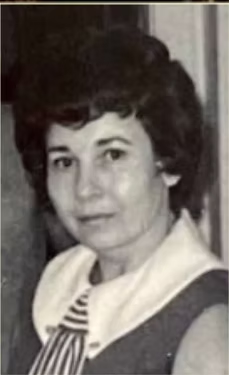
My mother

I was raised with overbearing affection by my mother, so that I felt growing up no one could have loved me more. She was always there for me, coming to my ballgames, walking me to school, when I was bullied for being a fat little kid, often with kids in my class, and even came with her to adult social functions in synagogues or events with organizations for Holocaust survivors. I even slept in her bed, often afraid to sleep alone until I was 11 or 12. But was it really what I had needed –smothering affection that forced me to question for years, and even today, I am often not convinced that I have been able to stand on my own.

The overbearing affection of my mother, I felt later in life, only left me far more enabled than was healthy. Growing up, I always considered myself very lazy, both physically and mentally. I never exercised much, didn’t study hard, and worked part-time for my father delivering cars for his auto wholesale business – dropping cars off from one used car lot or car dealership to another. It was just a mindless, cush job. I blamed my mother for how I perceived myself as being incredibly lethargic. She never encouraged me to study, or work hard, or aspire to my own independence, really not have to think with my own mind. It was just growing up being raised that dependent upon her, so I would never leave her. That was in exchange for my lens of her darkness for my stepmother and father being hers.
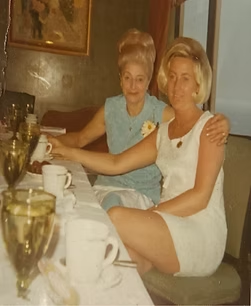
My German Stepmother on the left
I left home when I was eighteen, but I didn’t have another choice. It was for my own survival, realizing that I couldn’t live with my mother anymore, because of what traumatized her spiraling after the Holocaust, and the overbearing affection that I felt if it still continued, that I’d never be able to take care of myself. I was leaving home to save for my life, knowing that it might take with her. But, Unrelenting guilt followed me for leaving my mother in her condition, and sometimes, feeling how much she protected me growing up, instead of really seeing that what she was doing was more for her than for me.
I also was certain that I betrayed my mother when I left, when I began to develop a relationship with her bitter enemy of a lifetime– my German stepmother. The guilt never left me until something happened, standing next to my stepmother, visiting my mother lying in bed, five weeks before she died. When my mother was diagnosed with terminal cancer, my stepmother put aside over two decades of hatred between them and became her primary caretaker. The childhood trauma that never left me growing up, finally changed after something my mother did, which let me finally absolve the guilt that I couldn’t move past when I left home.

It’s pretty well known for Holocaust survivors that overprotection of their children is common, hearing the stories of how the Nazi’s separated families, murdered children, and any others who couldn’t work before everyone else. But I would never forget that her overprotection was also that she didn’t want me to leave her. How could she be alone after the loss of a large family in the Holocaust, and later in life, a husband whom she probably loved too much? What that must have done to her, probably knowing not long after they were married, that he never loved her. I wish that I had never blamed my mother as much as I did for how often, as I grew up, I felt that her affection ruined me, unquestionably more than saved me.  After everything she went through, I’m not certain anyone would have been able to act any differently. 

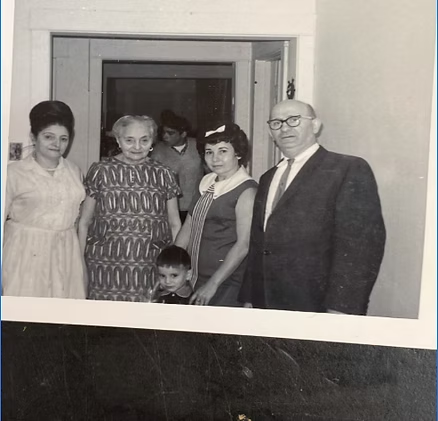
From Left to right:

Why Did I Become A Writer  – The Story I Needed To Tell

Why Did I Become A Writer  – The Story I Needed To Tell

I decided to change careers from my professional background in corporate banking, senior within risk management, to becoming a writer when I was laid off from my position with PNC Bank in late 2021. The voice inside me had grown too much and couldn’t be silent any longer. I had to write about the unconscionable injustices that I saw with racial bias in our own government, and after the Hamas attack on October 7th, over the Gaza border into Israel. 


The racial inequality of our perceptions and antisemitism that has been polarizing the world more than I’ve ever remembered, and hasn’t been more prevalent than since the Holocaust. I felt that what better way to let people see how dangerous segregation is for our lives than to be the themes of a memoir for my mother’s life, who was a “Schindler’s List” survivor who confronted generational trauma manifested in racism. My brother and I inherited my mother’s trauma of the undeserved lifetime of hatred for my German stepmother and every other German.


 If I could tell a story of my mother’s life being saved by Oskar Schindler – a Nazi German and the irony of how her children grew up, that might change how we look at people differently than ourselves, based on nothing more than our own bias. The research I conducted in both the Auschwitz and Plaszów concentration camps, where my mother was deported, helped me reach the intellectual capacity I needed to be well-versed in the details of this time period. I was convinced that I had to write this story, but also continue writing. My voice needed to be heard, and no one could take that away from me. How could anyone not feel the priceless wealth of the unforgettable moment when someone tells you, by what you’ve shared, they see the relevance of your experience for their own lives, especially if they feel a part of you living your story. 


After what I saw in the concentration camps in what my mother had to have lived through –dehumanized for what another human can do to another, while there alive and when they were dead, there was an unrelenting conviction to articulate where racial bias can lead and its penetration throughout the world over the Holocaust based on nothing more than conspiracy. While I could tell the story of Schindler, who was a member of the Nazi party, being the movement for the racist ideology that saw Jews only as parasitic vermin that must be exterminated on an unprecedented scale. The guilty who bore responsibility for the Holocaust. But after Schindler finally actually had seen the atrocities that were being inflicted on Jews in the ghettos and the camps, he saved my mother and many other unforgettable Jewish lives, who were not certain of their fate, which inevitably meant death. If nothing else, writing could let me tell everything I felt inside of how the road for inhumanity reached a penetration not even conscionable that led Schindler to find humanity when there were very few that did in a world that didn’t feel differently. 


Writing has also left me the rite of passage – the cathartic outlet that I never needed as much as I felt that I did. It‘s let me find a release for the trauma my brother and I inherited, being the victims of everything my mother went through in the Holocaust, and when my father left her. There was no way she could ever see what it had done to her and had inflicted on her children. The voice that I never was able to share before has let me legitimize the pain. But more than anything, it is my insatiable ambition to share the weight of the losses from what happened to our family. Hopefully, it’s learning that will stay with others to not let what we couldn’t help happen to them. 


Finally, writing is not only an expression that lets your voice be heard, but it also shows there is unquestionable hope when you feel no one else will listen. It’s been that hard to understand, and honestly heartbreaking, when that many synagogues and sanctuaries for Holocaust remembrance have not been receptive to a story of a Schindler Jew that confronts generational trauma manifested in racism. But what you write can let you feel that you can reach everyone with what you have to tell them. How much do you remember the unforgettable emotion of finding real certainty that many others understand your story and everything it hopefully opens for what it means in their own lives.


Kristallnacht – Through the Eyes of a Schindler Survivor’s Son

Kristallnacht – Through the Eyes of a Schindler Survivor’s Son

Featured on the Times of Israel Blog


On the night of November 9-10, 1938, Nazi German leaders unleashed a nationwide


antisemitic riot.  This week marked 87 years after this unconscionable event. The violence was supposed to appear as an unplanned outburst of popular anger against Jews. But in reality, it was state-sponsored terror of Jews manifested in vandalism and fear.  The riot came to be known as Kristallnacht – “The Night of Broken Glass” or “The November Pogrom.”  The widespread terror throughout the country was seen in 1400 synagogues that were burned by the Nazis – religious objects that were desecrated.  There was also vandalism of thousands of Jewish-owned businesses, and the Nazis had broken into countless Jewish homes.  During Kristallnacht, the German police imprisoned about 26,000 Jewish men only because they were Jewish and deported them to concentration camps.


What led up to Kristallnacht was the increasingly restrictive and violent anti-Jewish measures in 1938 under the reign of Adolf Hitler. They were undertaken to drive Jews out of Germany.  During October 27 – 29th of that year, the Nazis deported more than 17,000 Jewish people – targeting Jews with Polish citizenship and passports in Germany.  It was the first mass deportation of Jews from the country.  It included the Grynszpan family.  The parents and two of the Grynszpan’s children had been deported from Hanover to Zbaszyn in Poland.  The family had a 17-year old son – living in Paris at the time.  After learning what happened to his family, he went to the German Embassy in Paris.  On the morning of November 7th, he shot and killed a German diplomat –  Ernst vom Rath.  Apparently, the murder was due to the son’s rage for the deportation of his family from Germany and other Jews with Polish citizenship.


Nazi leadership decided to use the murder as a long-anticipated excuse to undertake a national anti-wide Jewish riot.  Beginning on November 7th, Propaganda Minister for the Nazis, Joseph Goebbels, coordinated the Jewish violence and exploited the murder as part of a world Jewish conspiracy. The Nazi leadership cynically claimed that the pogrom was not organized in any way, and that the Jews themselves had provoked the righteous anger of the German people.


Kristallnacht was the impetus for the Holocaust manifested in hatred and executed with racial desecration – in short, dehumanization.  It’s origin rested in fundamental Nazi idealism – the hatred of others that were perceived as a threat to the Aryan race, especially Jews. Its effectiveness was executed in the manipulation of people’s minds – channeled through propaganda and conspiracy.  It was seen as ethnic cleansing based upon nothing that was real.

“The Night of Broken Glass” wasn’t due to revenge, or any form of justice for the vom Rath Murder.  It was nothing but unconscionable conspiracy.  The German nation had been told by the Nazis they must hold a religion, race, and culture accountable for the actions of one.


But Oskar Schindler, who saved my mother’s life and an immeasurable number of other Jewish lives in the Holocaust, finally differentiated himself from Nazi ideology.  They saw Jews as only parasitic vermin that must be exterminated on an unprecedented scale.  Schindler finally stood apart from the antisemitism that penetrated throughout Germany, the rest of Europe, and far too many others in every other part of the world.


My mother actually never told me she was a “Schindler” Jew until my father had told me that on Yom Kippur day, 1993, while in synagogue.  It was five years after she’d passed away.  The Rabbi’s sermon for Yom Kippur was the story of “Schindler’s List” due to the film being released in the coming weeks. Her trauma due to the Holocaust that manifested in hatred for Germans is why I felt that she never said to me or my brother that she was a “Schindler” survivor.  The story is being told in my debut book, In the Midst of Darkness, coming soon.


Initially, Schindler, as a member of the Nazi party – and its conviction to fascism -exploited Jews. Firstly, he confiscated the Emalia factory in Plaszow Poland from three Jewish owners in 1939.  Nazi decrees no longer would let Jews own property.  He also employed Jews due to being cheap labor, while knowing they were in a concentration camp, with barely enough food to survive.  But after he’d finally seen the atrocities that were being inflicted upon Jews in the Krakow Ghetto and the Plaszow concentration camp, he saved Jewish lives to a reach that was unforgettable. They were probably never more certain of their fate inevitably being death.   Schindler found humanity when there were very few that did in a world that didn’t feel differently.

 
The story of Oskar Schindler has been told along with the memory of Kristallnacht for us to see “That what brings us together can overcome what pulls us apart.”  The Night of Broken Glass that turned into the darkest chapter in the world’s history was based on nothing that was true, but Schindler eventually recognized that delusional reality after he’d seen the immeasurable carnage of the Holocaust, which infected a world. The learning by how we can’t forget what he did can’t be more pivotal since that time than now. He was a Nazi that risked his life and everything he had to save every Jewish life he could. The Jews were the race that the Nazi party convinced a nation and too many others everywhere else in the world, who were the enemies. 


How can we not, as a world, especially seeing the divide today, not want to act more like those amongst the righteous during the Holocaust  – people like Oskar Schindler, Irena Sendler, and Raoul Walberg –  non-Jews who saved Jews from a genocide?  But Schindler, apart from the others needed to see inhumanity to come back to humanity.  As we’ve seen from each of them, they weren’t influenced by others who were convinced of what they heard being the truth.  It’s our responsibility to act like they did that will let us prevent another genocide like the Holocaust from ever happening again.

Survivor And Inherited Trauma – The Shoah and 10/7

Survivor And Inherited Trauma – The Shoah and 10/7


There has been so much shared of survivors’ accounts of the atrocities they lived through in the Holocaust, but not nearly enough of the trauma they’ve passed onto their children, their children’s children and what future generations may have to bear.  If we only consider the approximately 11 million victims murdered in the Holocaust – of which there were six million Jewish lives, there must be at least that many survivors of family members and other relatives, who have probably been inflicted with survivor trauma.  That also doesn’t consider there may be at least that many descendants of survivors, who may live with generational trauma.


If we talk about the penetration of the unconscionable atrocities dictated by antisemitism due to the Holocaust and the trauma that it often leaves survivors and their descendants, we also cannot forget the impact of October 7th.  The trauma that survivors, witnesses and their descendants are left to confront of 1280 victims murdered by Hamas that day of unforgettable inhumanity or held in captivity.


Many who survived a time as catastrophic as the Holocaust and those in the aftermath of October 7th, including the survivors and families of the victims might not have been able to  or may never fully adjust to real life again.  Psychological research has found that survivor trauma and for the families of the victims during the Holocaust and October 7th will probably be inevitably passed on genetically to their descendants – let alone what future generations may need to confront.


I have felt Holocaust survivors could really begin to confront their trauma until nearly 50 years after the darkest era of history, when “Schindler’s List” was released in 1993 and Steven Spielberg founded the Shoah Foundation, a year later.  The “Brutalist,” a film released in early January this year, a three-time Academy Award winner deeply explores the impact of a Holocaust survivor living with trauma and confronting assimilating to life in America, being ruined by his past.


The film also lets us see what something like the Holocaust or October 7th. can do to the victims, when being forced to integrate back into society, without the help needed to reconcile what they’ve confronted.  Sometimes that only needs to be nothing more than sharing the trauma they live with to the depth needed.  But in other circumstances, especially unrelenting psychological fear needs to be treated professionally.


The Shoah Foundation has given a voice to over 59,000 Holocaust survivors for them to share their trauma since it was established in 1994, five years after my mother passed away.  After October 7th, the foundation also conducted interviews for survivor testimony and witnesses to share their account of the deadliest antisemitic attack since the Holocaust.  But that penetration of public consciousness also can’t be more needed for the descendants of survivors and witnesses of October 7th, that wont escape inheriting their parent’s trauma.  If not, the silence may only leave, or continue to leave them without enough awareness needed to really reconcile their trauma.


I have written a memoir titled “In the Midst of Darkness” – A Schindler’s List Survivor’s Story Never Told that tells what I know of my mother’s teenage life being a Schindler Jew that confronts “Second Generation” survivor trauma.  She was traumatized due to being a holocaust survivor, and that my dad left her when she was eight months pregnant with me for a German woman.  I never knew until five years after she passed away that she was a Schindler survivor.


My mother had been defined by her past after what she lived through in the Holocaust, and her  parents, four sisters and a brother, who were murdered in the gas chambers of the Auschwitz and Belzec death camps.  Her undeserved lifetime of hatred for my stepmother and every other German that my brother and I inherited helped lead to his nervous breakdown – a fate that was nearly mine.  He was institutionalized before even reaching 30. The Shoah Foundation and its right of passage for survivors to tell what happened to them in the Holocaust would have meant everything to my mother.  If she would have been able to share what she endured and lost, it may have helped to prevent some of her trauma that my brother and I inherited.


Jewish organizations, Holocaust museums and holocaust survivor groups have established support groups for descendants of survivors that live with Second and “Third” Generation (“2G & “3G”) trauma.  But that’s often where it ends.  The public socialization that’s needed for their stories hasn’t been anywhere even near what’s been seen for the stories of Holocaust survivors.  I only hope that as we see a new chapter of trauma that’s being confronted after October 7th, we provide much more of what’s needed for those impacted and their descendants compared to what’s been accessible for Holocaust survivors.  Despite that more of these resources have only been there for the past 30 years – coming after Schindler’s List and The Shoah Foundation was founded.


What’s really been that hard to understand and honestly heartbreaking is Holocaust museums, and many synagogues have not been very welcoming for a story of a Schindler Jew that confronts generational trauma.  Prominent institutions for Holocaust remembrance, including The US Holocaust Museum, The Museum of Jewish Heritage, The LA Holocaust Museum, The St. Louis Holocaust Museum, The Simon Wiesenthal Center, The Illinois Holocaust Museum and even The Shoah Foundation haven’t been very responsive, or receptive.


I’ve been told from these institutions they have other stories that are priorities, the story doesn’t align with their thematic programming, or mission, they can’t tell every story in a public format, or there are layers of bureaucracy that exist.  Maybe it’s the inherited trauma for descendants of survivors they don’t feel is worthwhile enough to be told to the reach we’ve given for survivor themselves.  But I can’t be certain.  What I do know is the descendants of survivors and future generations may need to confront due to the Holocaust and after October 7th need institutions of this nature to tell their stories.  How do they heal from the trauma they’ve inherited being left without enough of a public voice to share what they’ve confronted?  I’ve always known that “what you resist persists.”  That can’t be more real than for a trauma victim, especially someone who can’t tell their story.


If we realize, there may be 10 – 15 million descendants of holocaust survivors and thousands  that were impacted and their descendants by October 7th, who probably will be subject to trauma.  What they have to confront may even reach an unconscionable level.  Then how can we not give them every bit of compassion for the stories they need to tell?

Yom Kippur’s Meaning to the Son of a Schindler Jew

Yom Kippur’s Meaning to the Son of a Schindler Jew


On Yom Kippur day, October 1993, my rabbi’s sermon in synagogue was the story of the upcoming release next month of the movie “Schindler’s List.”  It had been five years after my mother passed away.  At the end of the Rabbi’s speech that day, my father who was sitting next to me in synagogue leaned over and told me something that she never did.  It was six words that I would never forget – “Your mother was on that list.”


In synagogue that day, 40% of the congregation were Holocaust survivors. Some I knew personally having lived in the neighborhood where the synagogue was located growing up.   I can’t even imagine what they might have been feeling, hearing in their schul the first major story of the Holocaust that Steven Spielberg had turned into a movie. Most importantly, it was a story of a Nazi German saving Jewish lives. A person who turned righteous when so few did, in history’s darkest period. If some of those survivors might have been like my mother, who were traumatized and hated all Germans, could hearing this story have changed anything for them? I have to believe it might have reconciled at least some of what they felt. How could it not?

My mother had mentioned to me several times what she knew of her parents and six brothers and sisters that were murdered in the gas chambers of Auschwitz. I also listened to the atrocities she lived through in the Plaszow concentration camp in Poland led by Amon Goth.  He was the camp’s SS Commander – “The Butcher of Plaszow.”  But she never told me that Oskar Schindler had saved her life from the fate of 6 million other Jews in the Holocaust.


Yom Kippur is the holiest day of the year in the Jewish religion, and I have always felt is the commitment to a reconciliation of the heart, the repentance and forgiveness foe our sins.  After a lifetime of hatred for my stepmother and every other German, I learned on Yom Kippur day that my mother and over 1200 Jewish lives were saved by a Nazi German. How much more could that have meant for me.  It led me to finally realize that every bit of my mother’s vengeance for my stepmother and all other Germans she’d inflicted upon us, that penetrated too far inside me and destroyed my brother was never deserved.

One of Steven Spielberg’s intentions for the girl in the red coat in “Schindler’s List was to represent how the Holocaust was visible to the world – “as obvious as a girl in a red coat, but too many ignored.  I’ve felt the memoir I’ve written “In the Midst of Darkness” being what I know of my mother’s teenage life as a Schindler survivor, which confronts Intergenerational (“Second Generation”) Trauma due to the holocaust, manifested in hatred as a form of racism is what my brother couldn’t see and probably even ignored due to how we grew up.


What I learned on Yom Kippur about my mother opened myself to really see the meaning I feel of the holiest day of the year in the Jewish faith.  It let me find lasting reconciliation I needed for my lifetime of hatred of my stepmother and every other German that I couldn’t have done before.  The learning by my past that I’m always especially reminded of on Yom Kippur day – resting in never losing hope that even In the Midst of Darkness, “we can still overcome what pulls us apart.” It’s what Oskar Schindler did for my mother and so many other Jewish lives he saved that no one else would.  How more important can that be for our world today being what I hope is often seen in the story I’ve told – living in an era that has never been more divided than since the Holocaust.


If you’d like to learn more about Robert Don, click here.