


Racial bias rarely appears without a foundation. It often begins with stories, assumptions, and warnings repeated until they seem true. When children hear that members of a racial, ethnic, or cultural group are dangerous, inferior, or untrustworthy, they may absorb those ideas before they are capable of questioning them.
Over time, inherited assumptions can become part of a person’s worldview. A stereotype stops feeling like an opinion and begins to feel like a fact. This is how bias becomes normalized: not necessarily through one dramatic lesson, but through repeated messages delivered by family members, communities, entertainment, and institutions.
Prejudice is sometimes transmitted through unresolved trauma. A person harmed by members of one group may begin to associate the entire group with danger. If those fears are repeatedly shared with children, the next generation can inherit anger toward people it has never personally encountered.
The power of learned ideology can also be seen in the choices of Oskar Schindler. As a member of the Nazi Party, Schindler initially operated within a society deeply shaped by Nazi beliefs and loyalties. Yet after witnessing the brutality inflicted on Jewish people in the Kraków Ghetto and the Plaszów concentration camp, he moved beyond that ideology and chose to act against the system surrounding him. Schindler ultimately helped save 1,248 Jewish lives, including Robert’s mother, demonstrating that even deeply embedded beliefs and social pressures do not have to determine a person’s actions. His story provides a powerful counterpoint to the way prejudice can be passed forward: harmful ideas may be learned and reinforced, but they can also be questioned, rejected, and replaced by the recognition of another person’s humanity.
Reducing racial bias requires awareness, honest self-examination, and meaningful contact with people outside our familiar circles. We must ask where our beliefs originated, whether they are supported by personal evidence, and whom they might harm.
Education also matters. Learning history helps us understand injustice, but history should deepen our humanity rather than encourage new forms of collective blame. Listening to individual stories enables us to recognize people as complex human beings instead of representatives of a category.
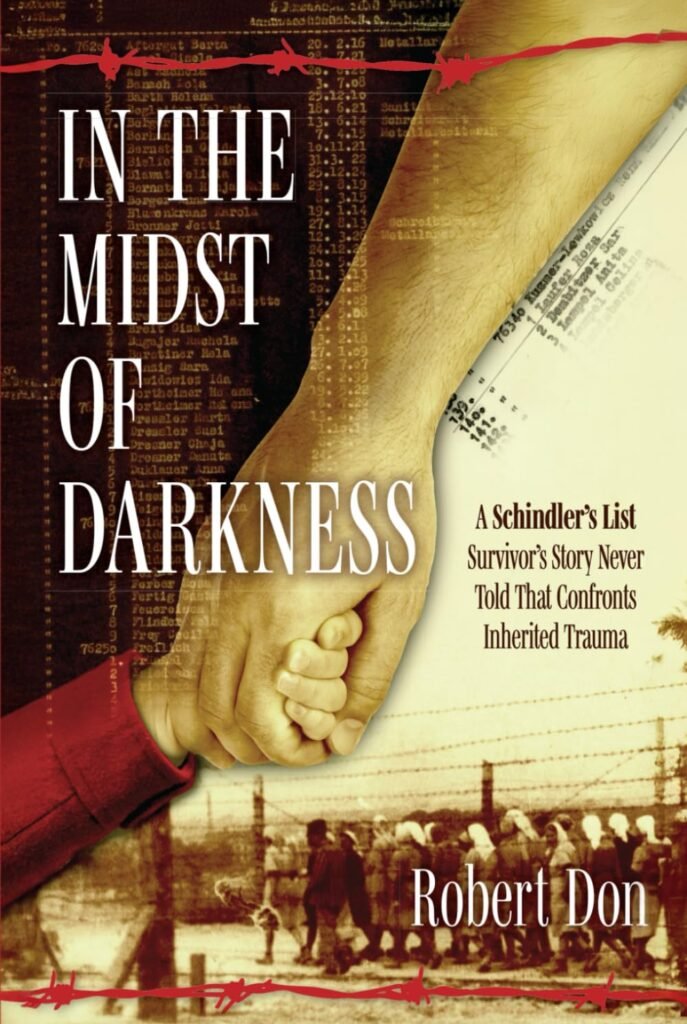
In the Midst of Darkness by Robert Don offers an intimate examination of inherited prejudice, family conflict, mental illness, compassion, and reconciliation. Through Robert Don’s experience, readers can see how hatred is taught and how a person can begin to unlearn it.
Choose the paperback, hardcover, or eBook edition and read the complete memoir. Share it with families, educators, book clubs, and community groups, then use its story to begin an honest conversation: Which beliefs have we inherited, whom have they prevented us from understanding, and what can we do today to break the cycle?