

How can a people who have experienced centuries of persecution now find themselves accused of persecuting others? This question has become increasingly significant in the debate surrounding Israel’s military operations in Gaza, particularly as accusations of genocide continue to dominate political demonstrations and public discourse. For Jewish people whose history includes discrimination, displacement, and the Holocaust, the suggestion that Israel has become an instrument of oppression creates a deeply painful historical contradiction.
As the son of a Holocaust survivor, I understand the emotional significance of that contradiction because I witnessed something similar within my own family. My mother survived Nazi concentration camps, lost her entire family, and carried the psychological consequences throughout her life. Yet the hatred that developed from her suffering eventually became a source of emotional oppression for my brother and me, a reality I explore in my memoir, In the Midst of Darkness.
Throughout history, Jewish communities have frequently existed as vulnerable minorities, experiencing religious discrimination, expulsions, antisemitic violence, and systematic persecution. The Holocaust represented the most devastating expression of this hatred, resulting in the murder of approximately six million Jewish people. Israel’s establishment in 1948 was intended to provide Jewish national self-determination and a refuge against future persecution.
Following Hamas’s October 7, 2023, attacks, Israel launched military operations in Gaza, arguing that its actions were necessary to protect its population and dismantle Hamas’s military capabilities. The scale of Palestinian civilian suffering and destruction has generated accusations of genocide, including allegations advanced by international human rights organizations and investigators.
Israel rejects those allegations and disputes the claim that its military campaign was conducted with genocidal intent. The legal definition of genocide requires particular prohibited acts and the specific intent to destroy a protected group, in whole or in part. Whether that threshold has been met must be assessed through evidence and international law rather than political slogans or historical comparisons alone.
My concern is that some political rhetoric moves beyond criticism of Israel’s government and assigns responsibility to Israeli Jews collectively, or even to Jewish communities elsewhere. Such generalizations disregard individual responsibility and risk transforming legitimate political debate into ethnic or religious prejudice.
My mother was unquestionably a victim of Nazi persecution, but her experiences did not prevent her from inflicting psychological suffering upon her children. When my father left her for Kathy, a German woman being pregnant with me, my mother’s unresolved Holocaust trauma amplified her hatred toward Germans, whom she associated collectively with the destruction of her family.
My brother and I were raised to view Kathy through those inherited beliefs, despite having no evidence that her family, as my mother felt, participated in or supported Nazi persecution. Our mother’s hatred became our hatred, beginning when we were only children and influencing our relationships for more than two decades.
The tragedy was that the woman who had survived through Oskar Schindler’s humanitarian actions never told us about his role in saving her and over 1200 other Jewish lives. I discovered that truth only after her death, leaving me to question whether knowing it earlier might have challenged the prejudices we inherited.
My mother’s experience demonstrates why victimhood and moral responsibility must be examined separately. She endured Nazi persecution, lost her parents and siblings, and survived concentration camps through the actions of Oskar Schindler. Yet she raised my brother and me to hate our German stepmother, Kathy, because of assumptions about her nationality and the suffering inflicted by Nazi Germany.
We were never given the opportunity to understand Kathy independently of our mother’s resentment. What makes this story particularly tragic is that Schindler, the man who helped save my mother’s life, was himself a member of the Nazi Party, a fact I did not discover until 1993.
That revelation challenged the generalized beliefs that had shaped my childhood. My mother had every right to grieve her family and condemn those responsible for the Holocaust, but she had no right to transfer collective guilt to innocent people or teach her children to hate them.
I wrote my memoir partly to challenge the assumption that a person’s history of victimhood makes their subsequent conduct immune from criticism. My mother’s suffering must be remembered, but the damage caused by her prejudice must also be acknowledged.
My mother’s victimhood was genuine, but it did not justify the harm she caused her children. Similarly, the Jewish people’s history of persecution does not automatically establish the morality of every Israeli government decision, just as allegations against Israel cannot justify condemning Jewish people collectively.
The comparison is not between the Holocaust and the Gaza war as equivalent historical events, but between the dangers of allowing collective identity to replace individual moral responsibility. Palestinians should not be held collectively responsible for Hamas’s atrocities, and Jewish people should not be treated as collectively responsible for Israeli military or political decisions.
Some of the major lessons from my memoir are that suffering deserves compassion without granting anyone unlimited moral authority over others. Recognizing this distinction is essential to preventing historical trauma from becoming a justification for further harm.
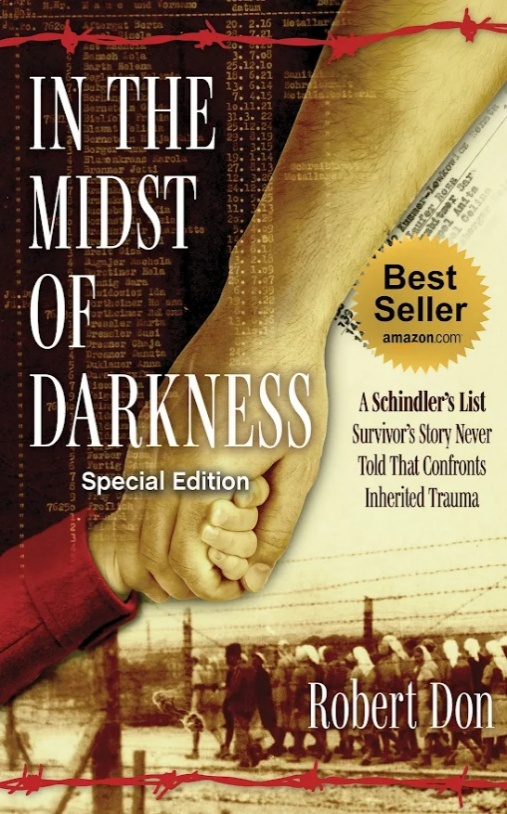
In In the Midst of Darkness, I, Robert Don, share the experiences of growing up with a Holocaust survivor whose unresolved suffering profoundly influenced her children. My story examines the consequences of inherited parental hatred, the emotional damage caused by family conflict, and the struggle to develop an independent understanding of people we were taught to feel contempt for.
The memoir also reveals how finally discovering my mother’s ties to Oskar Schindler transformed my understanding of her experiences during the Holocaust and the beliefs she passed down. Through this personal history, readers can explore the complicated relationship between victimhood, prejudice, compassion, and accountability. Get your copy today!